
Orbán escalates
There are two fundamental reasons and one tactical reason for Viktor Orbán’s escalation of tensions with Ukraine: the lingering “phantom pain” of Treaty of Trianon, strategic corruption, and the desir

Trianon phantom pain
The Treaty of Trianon (1920) reduced Hungary to roughly one third of its former territory and left about one third of ethnic Hungarians outside the new borders, in states such as Czechoslovakia, Romania, the Kingdom of Serbs, Croats and Slovenes (later Yugoslavia), and territories that today belong to Ukraine.
In Hungarian political culture, Trianon is widely regarded as a national catastrophe that continues to shape both domestic identity and foreign policy, particularly towards neighbouring states that host Hungarian minorities, including Ukraine. A representative nationwide survey conducted in 2020 by the Hungarian Academy of Sciences found that 94 per cent of Hungarians considered the treaty “unjust and excessive”. Such historical resentment remains a powerful political tool for mobilising constituencies.
Hungary’s population is slightly under 10 million. Between 75,000 and 120,000 ethnic Hungarians live in Ukraine, almost all of them in Zakarpattia Oblast. According to recent data from the World Bank and national statistics, Hungary’s total fertility rate was about 1.51 children per woman in 2023, well below the replacement level. Under a baseline scenario that assumes current fertility and migration trends continue, Hungary’s population could decline to around 8.5 million by 2050. A higher-fertility scenario would result in roughly 8.8 million people, while a low-migration scenario could reduce the population to about 8.2 million.
Against this demographic backdrop, ethnic Hungarians living abroad — including Hungarian communities in Ukraine — are increasingly viewed in Budapest as a valuable demographic and political asset.
Strategic corruption
While the EU and other European countries pursued policies aimed at reducing economic and energy dependence on Russia, the government of Viktor Orbán chose instead to exploit this policy. Since the start of the full-scale invasion of Ukraine, the EU has reduced its imports of Russian gas from 45 per cent to 19 per cent, and oil from 27 per cent to just 3 per cent. Meanwhile, Russia’s share of Hungary’s oil imports has increased from 60 per cent to 86 per cent.
In 2025, Hungary imported approximately 5–5.5 million tonnes of Russian crude oil, the overwhelming majority of which was delivered through the southern branch of the Druzhba pipeline. Since the full-scale invasion, Russia has repeatedly targeted Ukrainian energy infrastructure, including facilities connected to the pipeline. One such incident occurred on 27 January 2026. The Hungarian government demanded that supplies be immediately restored, claiming that the disruption resulted from a Ukrainian strike. Orbán subsequently accused Ukraine of preparing attacks against Hungarian energy infrastructure and ordered the deployment of armed forces to “protect” it.
In 2014 Hungary signed a contract with Russia to construct new units at the Paks Nuclear Power Plant. The Hungarian government did not revise these plans after either the annexation of Crimea in 2014 or the full-scale invasion of Ukraine in 2022. In 2025, the Court of Justice of the European Union ruled that the European Commission had failed to properly assess whether Hungary violated EU procurement rules when it awarded the contract directly to Rosatom without an open tender.
As has been the case with many European countries, including Ukraine until 2014, Russia has historically used its energy resources to secure political concessions. Hungary now ranks as the most corrupt member state of the EU.
As a form of political payoff, Orbán has repeatedly obstructed financial and military assistance to Ukraine and has sought exemptions for Russian entities and regime figures from EU sanctions lists. Hungary also delayed Sweden’s accession to NATO, aligning with Turkey to hold up ratification over unrelated grievances. Since the beginning of the full-scale invasion, Hungary has blocked the transit of Western military assistance to Ukraine through Hungarian territory and has repeatedly obstructed NATO–Ukraine cooperation.
For four years, Foreign Minister Péter Szijjártó visited Moscow thirteen times, but never travelled to Kyiv. Orbán himself visited Moscow twice and Ukraine only once wile on route to Moscow with a “peace-making” mission that had been requested by neither Ukraine nor the EU.
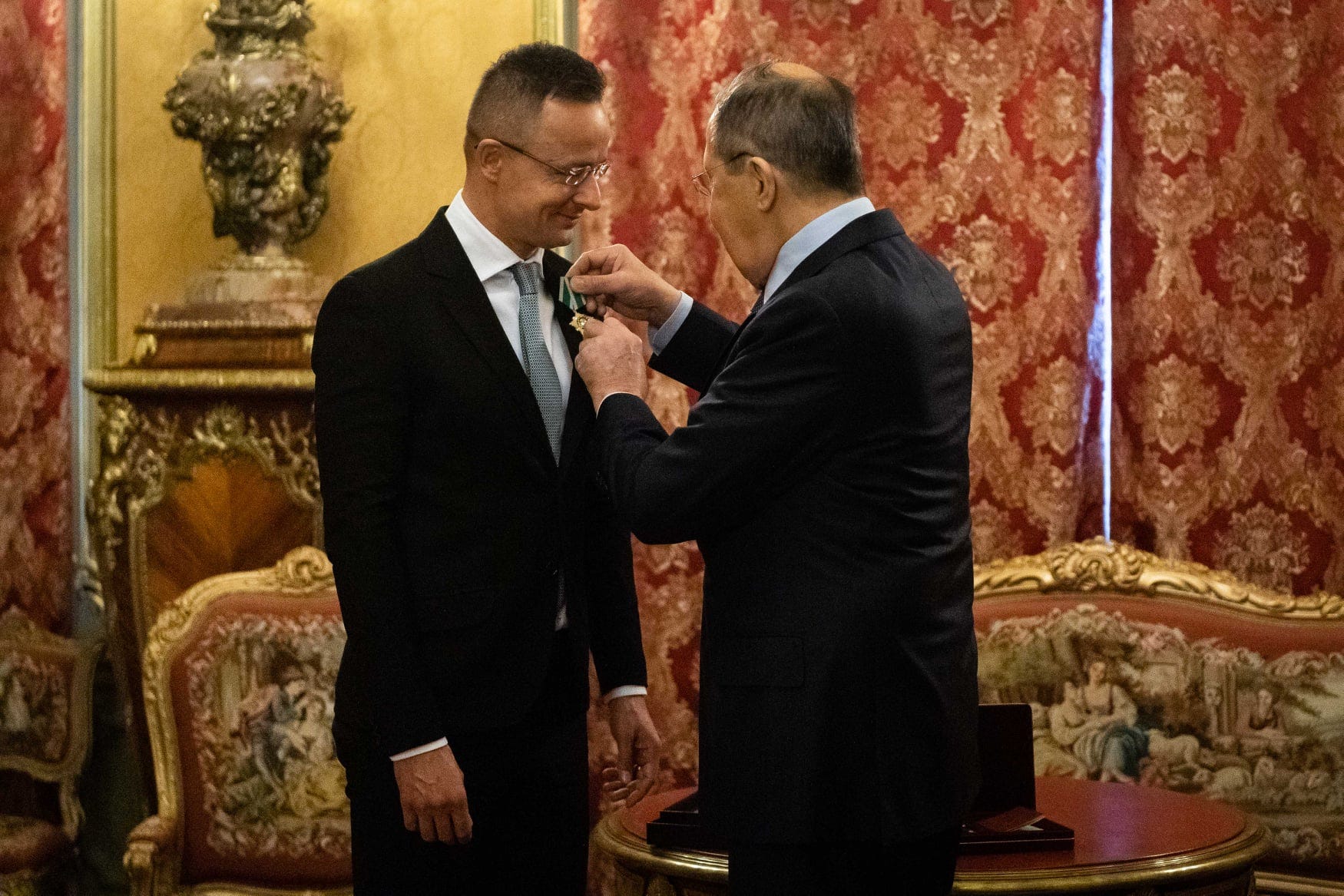
In 2025, Orbán organised a plebiscite intended to undermine Ukraine’s future membership of the EU. This move not only challenged the will of the Ukrainian people but also disregarded the views of representatives of the Hungarian minority in Ukraine.
As a group of Hungarian intellectuals wrote in an open letter to the Ukrainian people on 21 June 2025:
“…faced with the increasingly shameful anti-Ukrainian propaganda of the Orbán government, we express solidarity with the Ukrainian people and honor the soldiers of the Armed Forces of Ukraine who heroically defend their Motherland…
This is our vital interest: that the state we are neighboring does not become a vassal of Putin’s Russia, but remains an independent democracy in which all citizens, including national minorities, can freely exercise their rights.”
Staying in power
According to a February opinion poll, the ruling Fidesz party, with about 35 per cent support, is trailing the opposition Tisza Party, which polls at around 55 per cent. Facing the prospect of electoral defeat, Viktor Orbán has increasingly portrayed Ukraine as a hostile external actor that, he claims, supports the opposition leader. At the same time, he has intensified criticism of the leadership of the European Union, accusing it of being “warmongering”. Hungarian cities are now filled with posters attacking Volodymyr Zelenskyy and the EU. Viktor Orbán presents voters with a false binary choice: either support him or risk Hungary being dragged into the war.
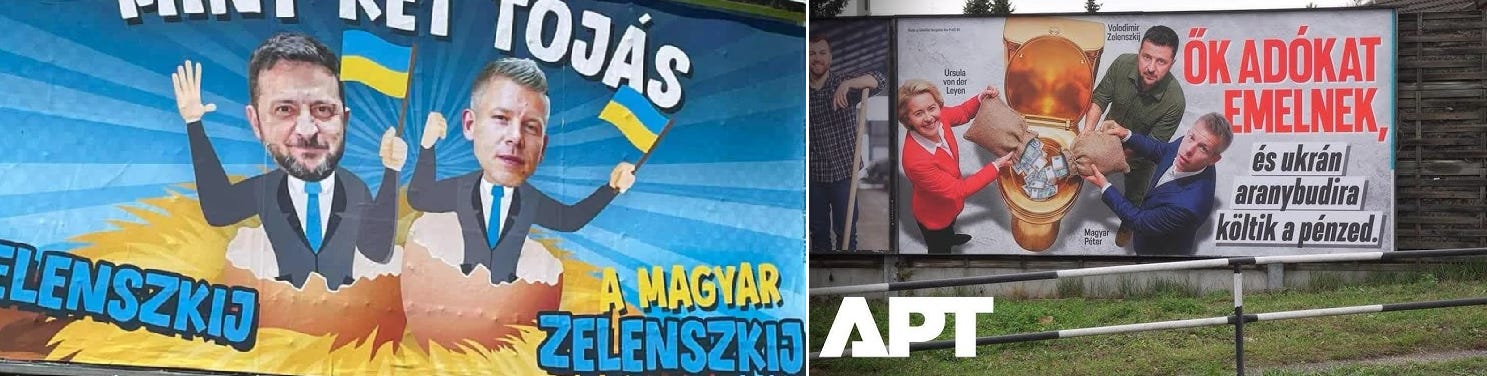
There have also been reports that Russia has deployed political strategists to Budapest to assist Orbán in maintaining power.
On 6 March 2026, Hungarian authorities detained employees of a Ukrainian state bank who were transferring hard currency and gold from Austria to Ukraine. The Hungarian government accused Ukraine of financing the opposition, although it provided no evidence to support this claim.
Orbán has been widely criticised by the EU for undermining freedom of speech, weakening the rule of law, and tolerating corruption. These concerns were a key reason why the EU decided to freeze cohesion funds allocated to Hungary. At the same time, Orbán enjoys considerable support among right-wing populist movements across Europe and within the MAGA movement in the United States.
Given these dynamics, further escalation should be expected in the run-up to the elections in April. There is little that Ukraine can realistically do to change the situation, given the depth of the grievances involved and the political stakes for Orbán. Ukrainians nevertheless hope that a possible change of government in Budapest could allow relations between the two countries to normalise, to the benefit of both states and their peoples.
Orban is going to start a war in order to stay in power.